Lipce commune
The PeasantsLipce commune is the local political and communal arena in which questions of land, work, taxation, and authority become matters of collective action. Its villagers can assemble in great numbers and defend shared interests, yet their unity is continually tested by poverty, local self-interest, and officials who exercise power over them.
Local Authority and Public Assemblies
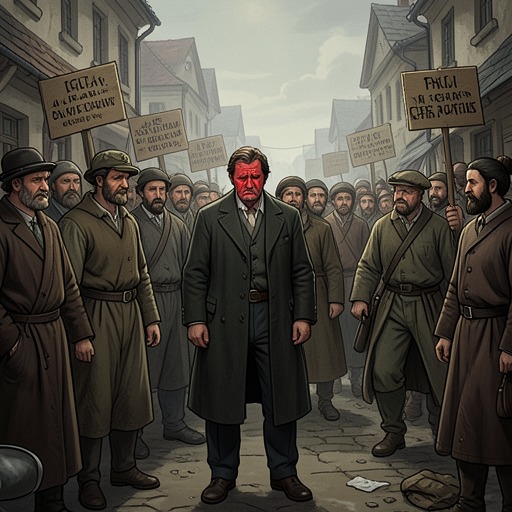
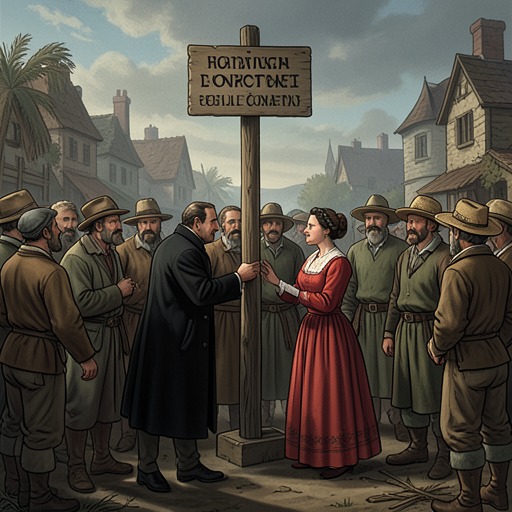
The commune’s public life is represented through gatherings before the chancellery and in the square, with the Voyt presiding over formal proceedings and the notary carrying out administrative business. The evidence does not present these bodies as institutions free from outside pressure: the notary summons farmers individually, reminds them of debts and dues, and uses promises and threats to extract goods or money. In a harsh preharvest season, some villagers lack even enough for salt. They bow, plead to pay later, or hand over their last zloty, while the notary presses them for taxes, court-building dues, oats, goslings, or straw.
The Voyt manages the school meeting while the notary prepares to read the document before the assembled villagers. The Voyt rings the bell and announces that proceedings are beginning; the notary reads aloud, and the crowd listens before reacting. The form of a public vote therefore gives the villagers a place to register a decision, but does not shield them from intimidation or manipulation. The notary warns that opposition could anger the Prefect and damage the villagers’ accord with the squire over the wood, tying one local issue to another and making political choice feel costly.
Land, Forest, and Livelihood
The commune’s strongest shared claim concerns access to land and forest resources. A dispute over pasturage is described as a conflict between what the register records and what the manor’s people claim: they repeatedly drive villagers away, and the pursuit has allegedly killed a cow and injured a boy. The complaint that the pasture is theirs “set down in the register clear as day” shows how formal records and lived customary claims are invoked together, while the suggested appeal to a court or commissioner points to official channels that villagers may attempt to use.
The forest carries an even broader weight. Maciej Boryna counts four morgen as his own and adds Jagna’s one morgen as he looks over the woodland, imagining the trees in terms of both property and an impending dispute with the manor. He believes the villagers are being wronged and insists that they will not simply stand by. The conflict also concerns employment: hired hands had expected work when the squire began felling at Wolf’s Hollow, but the squire refuses to employ men from Lipce after a complaint was lodged against him. Villagers describe winter hunger, frozen potatoes, and households surviving on one hot meal a day; the promised logging work had seemed a way to endure until spring.
The resulting grievance is not only a question of who owns the trees. Villagers argue that the manor is taking what they regard as their forest while also denying them work, after earlier complaints and legal recourse have failed to secure redress. Their claim joins resource access, customary right, and the expectation that decisions about local livelihoods should not be imposed without agreement.
Collective Mobilization and Its Limits
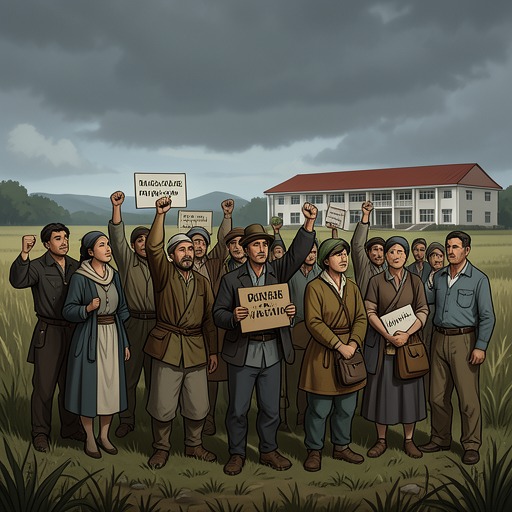
When the villagers gather before the inn, the square fills as people wait for the elders to fetch Maciej Boryna. He is regarded as the first farmer in the village, and the assembled farmers will not act without his leadership. The crowd’s physical arrangement—standing shoulder to shoulder, waiting in silence—becomes a visible form of collective readiness. The blacksmith and the miller try to deter the assembly, warning that its plans could put the whole village in chains, but their intervention fails; the villagers suspect that both men serve the manor’s interests.
Maciej Boryna addresses farmers and hired hands together, naming a common pattern of injury: the manor is felling the forest, refusing employment, and repeatedly driving the villagers toward ruin. He recalls that court cases and complaints have not helped, then urges the whole village to defend what it regards as its own. The call is answered with a shout to go to the forest. People hurry home to change clothes and fetch equipment; horses are harnessed, sleighs and carts brought out, and the village gathers with poles, pitchforks, flails, and scythes. Peasants, hired hands, women, and older children join the march. At the wood, they descend on the woodcutters, shouting that the forest is theirs and ordering them to leave.
This mobilization demonstrates the commune’s capacity for rapid, broad participation, but also its reliance on personal leadership and shared conviction rather than an uncontested formal process. Its unity is powerful in the moment; it does not erase disagreement over tactics, interests, or the risks of confronting authority.
The School Meeting and Political Voice
At the school meeting, most villagers incline toward voting against the proposal, and debate in the square grows increasingly forceful. When the notary calls for someone to run an errand to the manor, no one moves. The refusal is small but pointed: those assembled have come to decide an issue, not to serve as messengers. During the proceedings, Antek speaks up, but the Prefect has him excluded because he is under criminal investigation and therefore has no right to take part in the commune meeting. Antek leaves while urging the men not to approve the proposal and asserting that the law is on their side.
The crowd’s anger continues after his exclusion. Villagers close around the gendarmes, then allow them through and surge after them toward the Prefect. Their protest includes the complaint, “Every creature has its own tongue, but only we are ordered to use another’s.” In this assembly, a question put in administrative form becomes a confrontation over who may participate, whose speech counts, and how much authority the villagers can exercise when the Prefect and gendarmes are present. The commune can gather and make its opposition audible, but officials retain the power to define who is entitled to speak and to direct the proceedings.
Community, Inequality, and Significance
The commune is not a community of equal means. During the imprisonment of the men, Filipka’s daughter is found gravely weakened by hunger in a cold cottage where the windows are stuffed with straw, the family has no potatoes, and even the quilt has been sold. Florka gives birth while sick and without money or milk; with her husband imprisoned, there is no one to work the fields, which stand fallow as spring approaches. These accounts reveal how a crisis affecting the village falls especially hard on households already short of food, labor, and credit.
The same unequal burden appears in criticism of the better-off farmers, who are said to concern themselves with food and lending at high interest while poor neighbors suffer across the same village. Shared residence, in other words, does not automatically produce mutual aid. Lipce commune’s collective identity is strongest when villagers confront a clearly shared threat, such as the felling of the forest, but its poorer members may remain neglected within the community itself.
The commune’s political significance lies in this tension between organized voice and material vulnerability. Villagers can assemble, refuse an errand, challenge a decision, and mobilize against the manor; they can also be divided by private interests, burdened by administrative demands, or excluded from proceedings. Across the forest conflict and the school meeting, Lipce commune is shown not as a uniformly governed body but as a community repeatedly trying to turn common grievances into effective action.